
MAT vs. MOUD: What Is the Difference?
If you are searching for opioid treatment, you may see the terms MAT and MOUD used on clinic websites, insurance documents, healthcare resources, and government pages.
They are related, but they do not have exactly the same technical meaning.
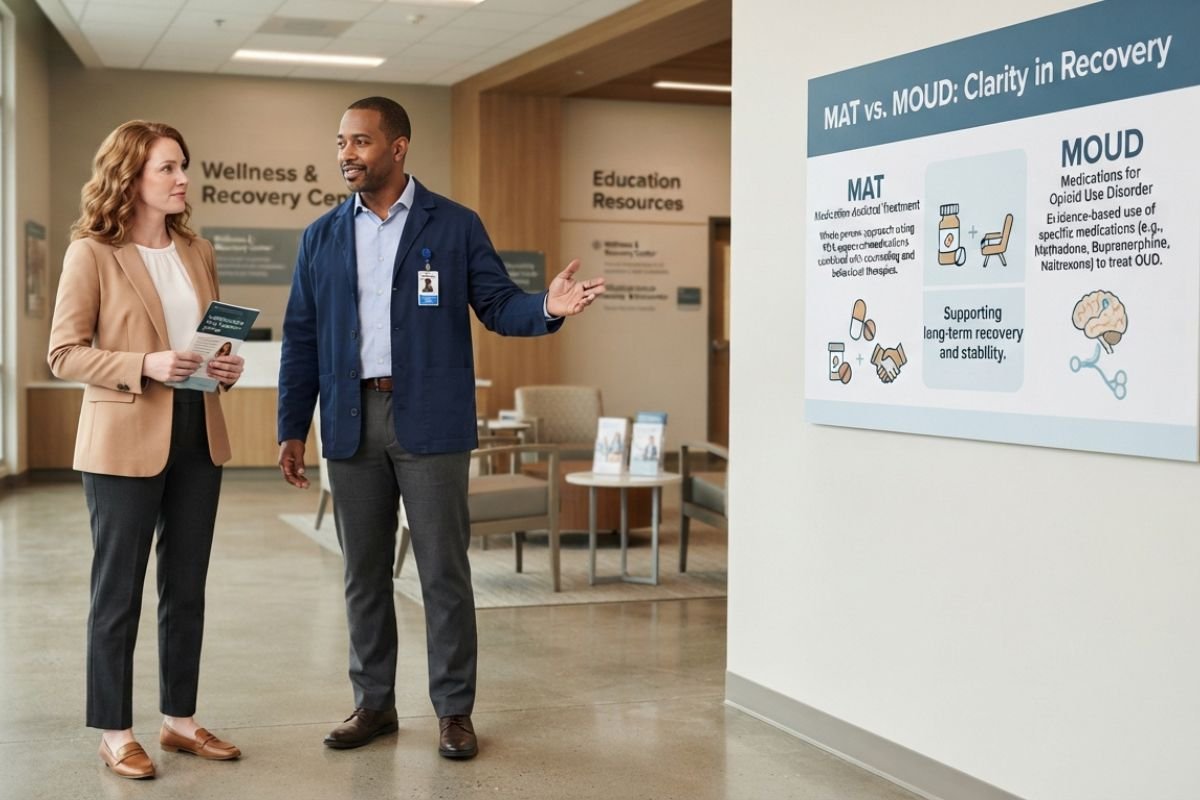
MAT, or Medication-Assisted Treatment, has traditionally described an approach that combines medication with counseling, behavioral treatment, and other support.
MOUD, or Medications for Opioid Use Disorder, specifically refers to medications used to treat opioid use disorder: methadone, buprenorphine, and naltrexone. SAMHSA has explained that the term MOUD helps emphasize that these medications are treatments in their own right rather than merely an “assist” to counseling. SAMHSA
In everyday healthcare, however, you may still see MAT and MOUD used for similar opioid-treatment services. A 2026 SAMHSA communication itself notes that use of FDA-approved OUD medications is commonly referred to as MAT or MOUD. SAMHSA
MAT vs. MOUD: The Short Answer
SAMHSA's current regulatory guidance states that the terms are not technically synonymous. MAT has traditionally meant medication combined with counseling and other behavioral interventions, while MOUD refers specifically to the FDA-approved medication categories used for OUD. SAMHSA
For the basic treatment model, see what Medication-Assisted Treatment is.
What Does MAT Mean?
MAT stands for Medication-Assisted Treatment.
Historically, federal resources defined MAT as the use of FDA-approved medication together with counseling and behavioral therapies to provide a whole-person approach to substance use disorder treatment. SAMHSA Library
The term became especially common in treatment for opioid use disorder, but MAT has also been used more broadly when discussing medication treatment for alcohol use disorder.
That broader usage is one reason newer terminology is more specific.
Instead of placing multiple conditions under one MAT label, current federal resources increasingly use:
SAMHSA's current treatment information lists methadone, buprenorphine, and naltrexone for OUD, while commonly used medications for AUD include acamprosate, disulfiram, and naltrexone. SAMHSA
What Does MOUD Mean?
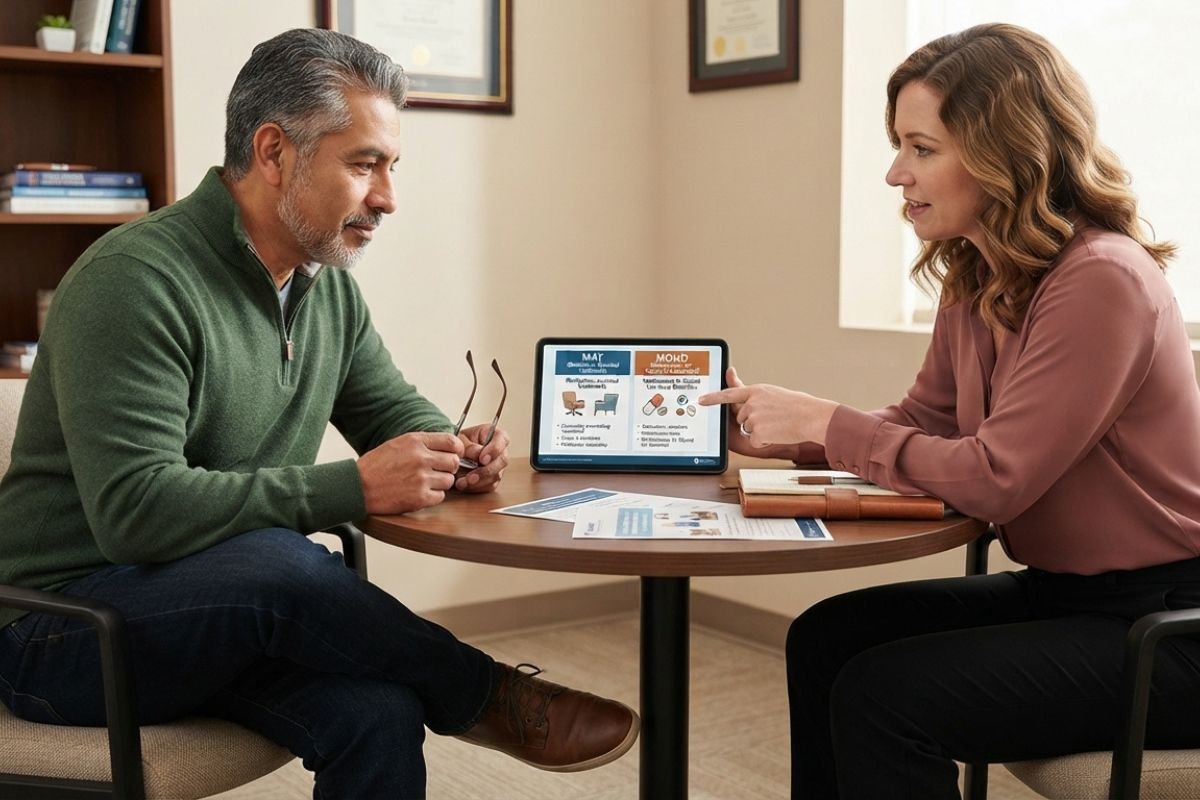
MOUD stands for Medications for Opioid Use Disorder.
It is diagnosis-specific: MOUD refers to medication treatment for opioid use disorder, including OUD involving heroin, fentanyl, or prescription opioids.
The FDA identifies three approved medication categories for treating OUD.

Methadone
A full opioid agonist used to treat OUD. When methadone is used for OUD in the United States, it generally must be dispensed through a SAMHSA-certified Opioid Treatment Program. SAMHSA
Learn about methadone treatment for opioid use disorder →Buprenorphine
A partial opioid agonist that can reduce opioid withdrawal and cravings. Unlike methadone for OUD, buprenorphine can be prescribed in a wider range of healthcare settings when applicable federal and state requirements are met. SAMHSA
See our buprenorphine treatment guide →Naltrexone
An opioid antagonist that blocks opioid receptors rather than activating them. Extended-release injectable naltrexone is FDA-approved for OUD. SAMHSA
Read about naltrexone for opioid use disorder →For an overview of all three options, visit medications for opioid use disorder.
Why Has the Language Shifted From MAT to MOUD?
Why “Assisted” Has Been Criticized
The word “assisted” in Medication-Assisted Treatment has received criticism because it can suggest that medication merely supports the “real” treatment, such as counseling.
SAMHSA's 42 CFR Part 8 FAQ explains that this wording has been criticized for implying that medications such as methadone and buprenorphine are less important than counseling. The agency notes that medications can be an integral part of treating a chronic substance use disorder, not an ancillary treatment. SAMHSA
Why MOUD Is More Specific
Using MOUD makes the medical purpose explicit: these are medications used to treat opioid use disorder.
The shift also helps distinguish opioid medication treatment from MAUD, or medications for alcohol use disorder.
However, MAT has not disappeared. Patients, clinics, insurers, state programs, and websites still use the term, and SAMHSA itself acknowledged in 2026 that medication treatment for OUD is commonly called either MAT or MOUD. SAMHSA
So seeing the term MAT does not automatically mean the information or treatment is outdated.
Are MAT and MOUD Interchangeable?
Often
If someone says they are looking for a “MAT clinic,” they may actually be looking for a clinic that provides methadone, buprenorphine, naltrexone, or other medication-based treatment.
Similarly, a treatment center may advertise a “MAT program” while current clinical documentation refers to the medication as MOUD.
Not Exactly
SAMHSA's technical distinction remains useful: MAT describes the broader historical treatment framework, while MOUD specifically identifies medication treatment for OUD. SAMHSA
This distinction becomes particularly useful when comparing opioid treatment with medication treatment for other conditions.
What About MAUD?
MAUD means Medications for Alcohol Use Disorder.
Current SAMHSA terminology separates medications by the condition being treated. MOUD applies to opioid use disorder, while MAUD applies to alcohol use disorder. SAMHSA
This makes terminology more precise than using MAT for every medication-based substance use treatment.
For example, naltrexone can be used in treatment for both OUD and AUD, but its role, formulation, treatment requirements, and clinical considerations differ depending on the condition. SAMHSA
This is why MATClinicGuide.com can use the familiar term MAT for navigation while still using MOUD or MAUD when referring to a specific medical treatment category.
Does MOUD Require Counseling?
Counseling and behavioral-health services can be valuable parts of opioid treatment, but medication should not automatically be withheld because counseling is unavailable or because a patient declines it.
SAMHSA's current buprenorphine guidance states that counseling is strongly recommended where appropriate, but inability to provide counseling—or a patient's decision not to participate—should not prevent buprenorphine prescribing. SAMHSA
FDA gives similar guidance, stating that OUD medication should include an offer of counseling or related services when possible, but medication treatment should not be contingent on participating in those additional services. U.S. Food and Drug Administration
Opioid Treatment Programs have specific requirements to make counseling and other services available. Under current federal OTP rules, however, a patient who does not wish to participate in counseling cannot be denied MOUD solely for that reason. SAMHSA
This nuance is one reason the phrase “medication-assisted” can sometimes create confusion.
Why MOUD Matters
MOUD is not merely a terminology issue. Access remains limited.
According to the 2025 National Survey on Drug Use and Health, about 4.0 million people aged 12 or older had opioid use disorder during the past year. Only about 623,000 people with past-year OUD—15.7%—received MOUD during 2025. SAMHSA
FDA describes methadone, buprenorphine, and naltrexone as safe and effective treatments for OUD. U.S. Food and Drug Administration
The terminology therefore matters partly because clear language can help patients understand that these medications are legitimate medical treatments for opioid use disorder.
Does “MAT Clinic” Mean the Same Thing as an Opioid Treatment Program?
Not necessarily.
“MAT clinic” is commonly used as a consumer-facing description for facilities or healthcare practices that provide medication-based substance use treatment.
An Opioid Treatment Program (OTP) is a specifically certified and accredited program operating under federal opioid-treatment regulations. SAMHSA oversees OTP certification under 42 CFR Part 8. SAMHSA
This matters most for methadone.
Methadone used to treat OUD generally can only be dispensed through a SAMHSA-certified OTP. Buprenorphine and naltrexone can be available in other healthcare settings as well. SAMHSA
So someone searching for a MAT clinic may actually need one of several different provider types depending on the medication they are considering.
Learn more about what a MAT clinic is or read about Opioid Treatment Programs.
Which Term Should Patients Use When Looking for Treatment?
There is no need to know perfect clinical terminology before seeking help.
Someone searching “MAT clinic near me” may find medication treatment. Someone searching “MOUD treatment” may reach the same or similar services.
More specific searches can be useful when the preferred medication is already known.
For methadone treatment, looking specifically for a certified OTP can help because of federal dispensing requirements. For buprenorphine, treatment may be available through addiction clinics, outpatient programs, primary-care practices, or other qualified healthcare settings. SAMHSA
Readers can start with our MAT clinic directory and compare available treatment options by location and medication.

Frequently Asked Questions About MAT vs. MOUD
Is MOUD the new name for MAT?
Not exactly. MOUD is a more precise term for medications used specifically to treat opioid use disorder. MAT is an older and broader treatment term. The two frequently overlap in real-world use, but SAMHSA does not technically define them as synonymous. SAMHSA
What medications count as MOUD?
The three FDA-approved medication categories are methadone, buprenorphine, and naltrexone. U.S. Food and Drug Administration
Does MAT include alcohol treatment?
MAT has historically been used broadly for medication-supported substance use treatment, including OUD and AUD. Current federal terminology increasingly distinguishes MOUD for opioid use disorder and MAUD for alcohol use disorder. SAMHSA
Is Suboxone considered MOUD?
Yes. Suboxone contains buprenorphine and naloxone. Buprenorphine is one of the FDA-approved medication categories used to treat opioid use disorder.
Is methadone MOUD?
Yes. Methadone is an FDA-approved medication for OUD. When used for OUD, it generally must be dispensed by a SAMHSA-certified OTP. SAMHSA
Is counseling required for MOUD?
Counseling and behavioral support may be helpful and should be offered when appropriate, but current federal guidance says access to medication should not automatically depend on participation in counseling. SAMHSA
Is MOUD replacing the term MAT completely?
No. MOUD is increasingly common in federal and clinical resources, but MAT remains widely recognized. SAMHSA's 2026 guidance acknowledges that both terms continue to be used. SAMHSA
Is a MAT clinic always a methadone clinic?
No. A provider described as a MAT clinic may offer buprenorphine, naltrexone, methadone, or other medication-based treatment depending on its services and regulatory status. Methadone dispensing for OUD has specific OTP requirements. SAMHSA
Find Medication Treatment for Opioid Use Disorder
Whether a provider calls its services MAT, MOUD, opioid treatment, or medication-based treatment, the more important questions are what medications it actually offers, whether the services match your needs, and whether the provider meets applicable clinical and regulatory requirements.
MAT Clinic Guide can help users understand medication options and explore treatment providers by location.
Important Safety Information
This page provides general educational information about MAT, MOUD, opioid use disorder treatment, and treatment terminology. It is not medical advice and should not be used to select, start, stop, or change a medication.
Medication choice depends on individual medical history, opioid use, other substances, treatment goals, medication availability, and other clinical factors.